
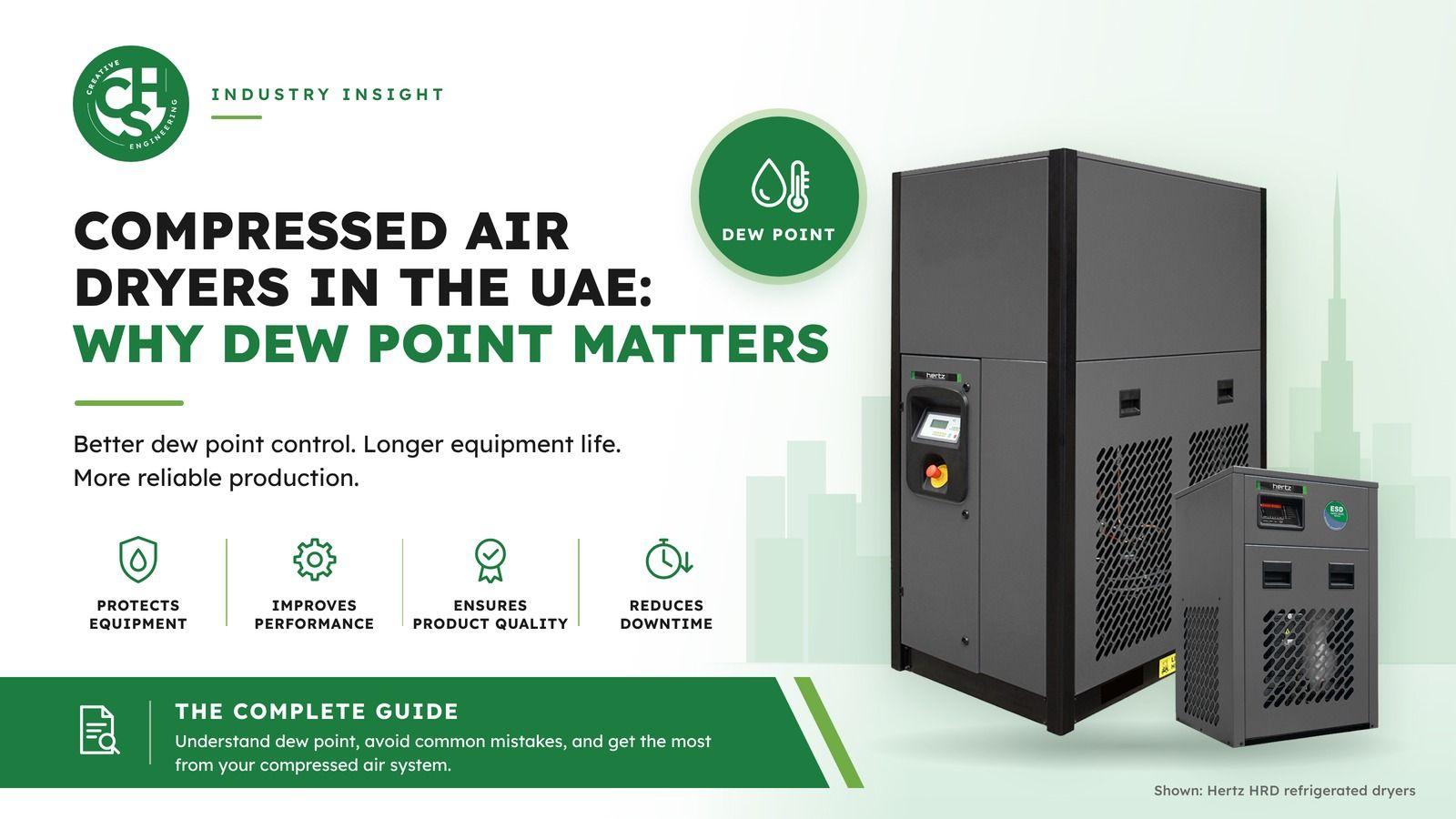
Compressed Air Dryers in the UAE: Why Dew Point Matters More Here Than Almost Anywhere Else
Every compressor produces moisture. Atmospheric air contains water vapour, and when it is compressed, that vapour concentrates. A compressor drawing in ambient air at 35 degrees Celsius and 70% relative humidity, typical UAE summer conditions at ground level, will produce compressed air with a moisture content that, if left untreated, condenses inside pipework, damages actuators and instruments, corrodes fittings, and in sensitive applications contaminates the product the compressed air is supposed to protect.
A compressed air dryer removes that moisture before it reaches the distribution network. This is not optional equipment for most industrial applications. It is as fundamental to a compressed air system as the compressor itself. And yet, in the UAE, dryer selection and performance monitoring are two areas that are routinely underestimated, with real consequences for equipment life and production quality.
CHS supplies Hertz compressed air dryers and treatment equipment for UAE industrial facilities in both refrigerated and adsorption types. The starting point for any dryer recommendation is the same as for any other piece of compressed air equipment: understanding what your application actually requires, not specifying to a generic standard.
Why Moisture in Compressed Air Is a Problem
The consequences of wet compressed air vary by application, but they fall into four consistent categories.
Corrosion inside the distribution network. Water inside a steel compressed air pipe network causes rust. That rust sheds particles into the air stream, which reach valves, actuators, and instruments downstream. Corrosion is slow and cumulative, which is why facilities often do not connect pipework deterioration to dryer performance until something fails. Wet air and leaking air tend to occur in the same neglected systems, and the two problems compound each other.
Instrument and actuator damage. Pneumatic instruments, positioners, and valve actuators are designed to operate on clean, dry air. Water inside these components causes internal corrosion, swells seals, and in cold weather (relevant for UAE facilities with chilled warehouse or cold-chain sections) causes freezing. Instrument failures in a process plant or a food production line are expensive and, in some applications, a safety issue.
Product contamination. In food and beverage processing, pharmaceutical manufacturing, and electronics production, compressed air contacts the product directly or indirectly. Moisture in the air stream is a contamination risk. Regulatory standards in these sectors specify maximum moisture content in compressed air, and failing to meet them has commercial and compliance consequences.
Compressed air tool wear. Pneumatic tools used in fabrication and assembly depend on dry air for lubrication film integrity. Wet air degrades the lubricating film, increases wear on internal components, and shortens service life. This is a lower-severity consequence than instrument failure or product contamination, but it is a real and ongoing cost across a workshop or production floor.
What Dew Point Means and Why It Is the Right Measure
Dew point is the temperature at which moisture in compressed air begins to condense into liquid water. A lower dew point means drier air. A higher dew point means more moisture is present and condensation can occur at higher ambient temperatures.
The reason dew point is the correct measure, rather than relative humidity, is that it is absolute. Relative humidity describes moisture content relative to the air's capacity at its current temperature. As compressed air cools in the distribution network, relative humidity rises even if no additional moisture enters the system. Dew point does not change with temperature, which makes it the stable, comparable measure for specifying and monitoring dryer performance.
In practice, compressed air dryers are specified to achieve a target pressure dew point (PDP): the dew point of the air at the working pressure of the system. The ISO 8573-1 standard classifies compressed air quality into classes based on pressure dew point, particle count, and oil content. For dryer selection in UAE facilities, the relevant dew point classes are:
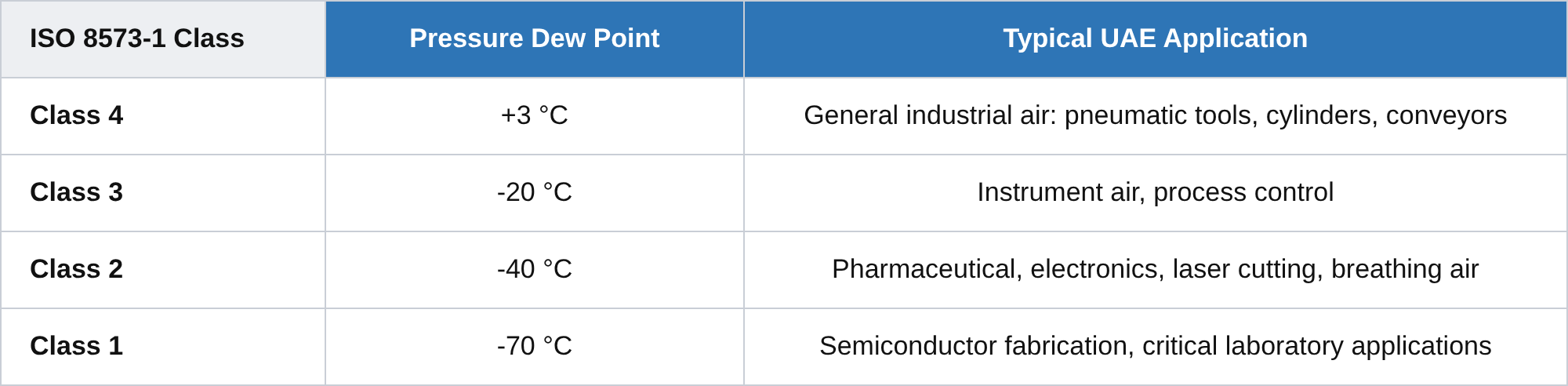
For most general industrial applications in UAE facilities, a refrigerated dryer delivering Class 4 air is the appropriate and cost-effective choice. For instrument air and process control applications, Class 3 is typically required. Pharmaceutical, electronics, and food processing facilities producing product-contact air generally need Class 2, which requires adsorption drying technology rather than refrigeration.
The Two Main Dryer Technologies and When Each Fits
Refrigerated Dryers
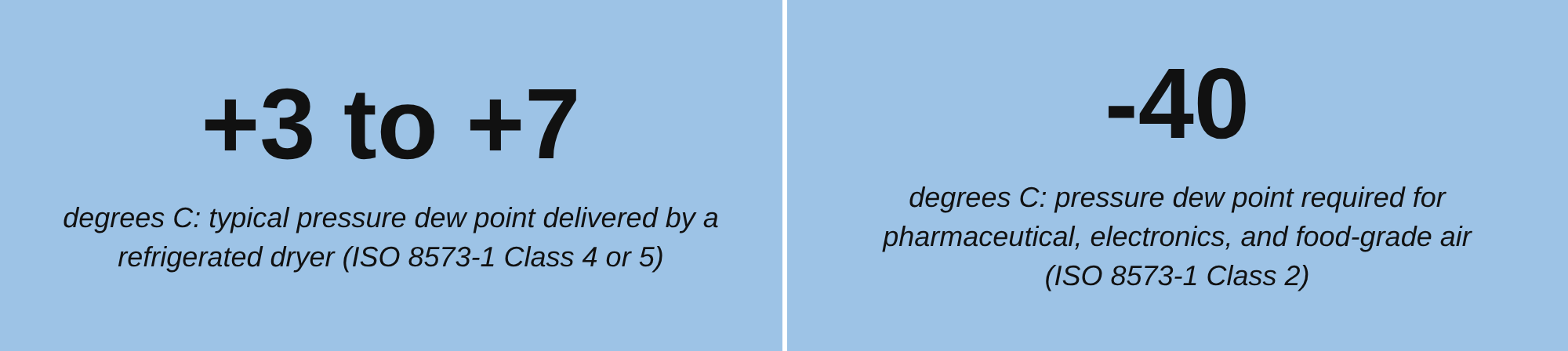
A refrigerated dryer cools compressed air to a temperature at which most of the moisture condenses and is drained away, then reheats the air to prevent condensation in the pipework. The typical pressure dew point achieved is between +3 and +7 degrees Celsius, which is ISO 8573-1 Class 4 or 5.
Cycling vs non-cycling refrigerated dryers. A non-cycling refrigerated dryer runs its refrigeration compressor continuously. A cycling dryer stores cooling energy in a thermal mass and runs the refrigeration compressor intermittently, matching cooling output to actual load. In a UAE facility with variable compressed air demand across shifts, a cycling dryer reduces energy consumption during lighter periods in the same way a VSD compressor does.
For facilities where the dryer runs continuously at near-full load, the energy saving from cycling technology is smaller.
Adsorption Dryers (Desiccant Dryers)
An adsorption dryer passes compressed air through a bed of desiccant material, typically activated alumina or molecular sieve, which absorbs moisture from the air stream. The desiccant is then regenerated by driving off the absorbed moisture, either using a portion of the dried air (heatless adsorption) or using an external heat source (heated adsorption or blower purge).
Adsorption dryers achieve dew points of -40 degrees Celsius and below, delivering ISO 8573-1 Class 2 or Class 1 air. They are the required technology for pharmaceutical manufacturing, electronics production, laser cutting systems, and any application where the distribution network passes through chilled or cold-chain environments.
Heatless vs heated adsorption. A heatless adsorption dryer uses 15-20% of its dried air output for desiccant regeneration, per the Compressed Air Challenge. That purge air is vented to atmosphere, representing a real energy cost. A heated adsorption dryer uses an external heat source to regenerate the desiccant, reducing purge air losses significantly. For UAE facilities with high compressed air demand and a requirement for very dry air, the energy saving from heated adsorption technology is worth evaluating against the higher capital cost.
Not sure which dryer technology your application needs? CHS provides free site assessments covering compressed air quality requirements, dew point specification, and dryer selection across the Hertz range.
Why UAE Conditions Change the Calculation
Most refrigerated dryers, including the Hertz HRD range, are rated at ISO 7183 reference conditions: compressed air entering at 35 degrees Celsius and 7 bar, in a room at 25 degrees Celsius.
In a UAE industrial facility from June to September, the actual conditions are significantly different. Ambient temperatures in compressor rooms regularly exceed 45 degrees Celsius. Compressed air temperatures at the compressor outlet can reach 70-80 degrees Celsius before the after-cooler. Cooling air across a refrigerated dryer's condenser is 20 degrees or more above the ISO reference condition.
The practical effect is that a refrigerated dryer rated at a given dew point under ISO conditions will deliver a higher (worse) dew point under UAE summer conditions. Hertz publishes correction factors that show how big the effect is. At 50 degrees Celsius ambient, an HRD dryer can handle only 70% of its rated flow and still hold its dew point. If the air coming in is also at 50 degrees Celsius, that drops to under half. A dryer sized on catalogue figures will be overloaded in July, and its dew point will rise.
This has two practical implications for UAE facilities. First, dryer selection should account for actual UAE ambient conditions, not ISO reference conditions. CHS specifies dryers based on the site conditions at your facility, not catalogue values. Water-cooled compressors also deliver lower outlet air temperatures than air-cooled equivalents, which reduces the thermal load on the dryer and improves its performance under UAE summer conditions.
Second, continuous dew point monitoring is the only reliable way to confirm that your dryer is delivering its specified performance under summer load. Without measurement, a dryer performing below specification in July can go undetected until a downstream instrument fails or a product quality issue surfaces.
The smart monitoring blog in this series covers dew point monitoring in detail. The short version: a CS Instruments dew point sensor at the dryer outlet, connected to a continuous monitoring dashboard, gives real-time confirmation that the dryer is performing as specified and flags any drift before it becomes a problem.
Dew Point Standards by Industry
The dew point requirement for compressed air is set by the most sensitive application in the facility that uses it. A packaging line feeding both pneumatic actuators and a direct product-contact blowing station needs to meet the standard for the product-contact application across the whole system, or the distribution network needs to be split into zones with different treatment levels.
The table below summarises typical dew point requirements for common UAE industrial sectors. These are guidelines, not substitutes for the specific requirements of your process, equipment manufacturer specifications, or applicable regulatory standards.
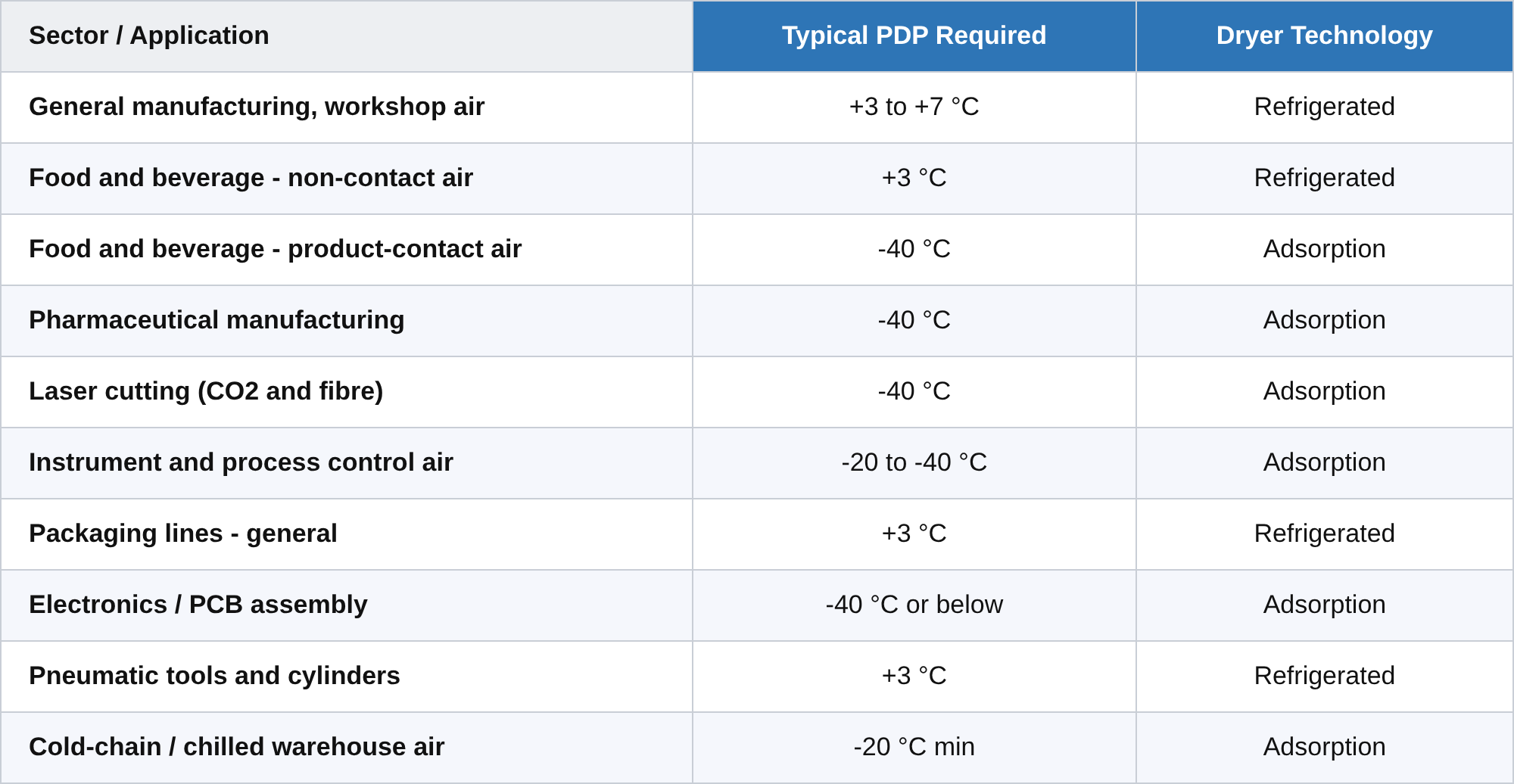
For facilities serving multiple applications from a single compressed air ring main, CHS advises on whether a single high-specification dryer for the whole system is more cost-effective than a zone-by-zone approach with different treatment levels. The answer depends on the flow volume at each specification level and the capital and operating cost difference between the two approaches.
How to Know Whether Your Dryer Is Actually Working
Dryer performance is invisible without measurement. A refrigerated dryer that has a partially blocked condenser, degraded refrigerant charge, or undersized capacity for actual UAE summer inlet conditions will run without tripping any alarm, deliver air that feels dry, and produce a dew point that is worse than specified. The consequences appear downstream, often weeks or months later, as corrosion, instrument drift, or in a food or pharmaceutical facility, a product quality issue.
The most important maintenance actions for compressed air dryers in UAE conditions are:
- Condenser cleaning. Refrigerated dryers rely on airflow across the condenser coil to remove heat. In UAE industrial environments with dust, sand, and airborne particulates, the condenser fouls more quickly than in temperate climates. A partially blocked condenser raises the refrigerant head pressure, reduces cooling capacity, and increases dew point. Condenser cleaning should be part of every service visit and more frequent during sandstorm season.
- Condensate drain function check. The drain removes liquid water from the dryer. A blocked or failed drain allows water to carry over into the distribution network. Drain function should be verified at every service.
- Dew point measurement at the dryer outlet. A single periodic dew point measurement with a portable instrument at service intervals gives a point-in-time reading. Continuous monitoring from a fixed sensor gives a trend and flags performance drift between service visits. For applications where dew point is critical, continuous monitoring is the appropriate standard.
- Desiccant condition check (adsorption dryers). Desiccant beds have a finite service life and can be contaminated by oil carryover from the compressor if the upstream filtration is not maintained correctly. A contaminated desiccant bed will not achieve the specified dew point regardless of how well the dryer itself is functioning.
FAQ: Compressed Air Dryers for UAE Facilities
Do I need a dryer if my compressor has an after-cooler?
Yes. An after-cooler reduces the temperature of compressed air leaving the compressor and causes some moisture to condense and drain away. It does not dry the air to a level suitable for instrument air, food processing, or any other application with a dew point specification. The after-cooler is the first stage of moisture removal. The dryer is the treatment stage that delivers the specified dew point.
Can I use one dryer for the whole facility if some areas need drier air than others?
You can, and in many facilities it is the simplest approach: specify the dryer for the most demanding application and supply the whole system from it. Whether this is the most cost-effective approach depends on the volume of air used in the high-specification zone versus the rest of the system. If a small proportion of total flow requires very dry air, a dedicated point-of-use adsorption dryer for that zone, fed from the main refrigerated dryer network, is often the better solution. CHS designs both configurations and advises based on your actual flow data.
How often does a refrigerated dryer need servicing in UAE conditions?
Hertz refrigerated dryers should be serviced at the manufacturer's recommended intervals, but in UAE conditions two additional checks are worth building into the programme. Condenser cleaning should happen more frequently than the standard schedule due to dust and particulate loading, particularly during seasonal dust events. Condensate drain function should be verified at every service visit. CHS service programmes for UAE facilities are designed around actual operating conditions, not European reference schedules.
What happens if my dryer is undersized for UAE summer conditions?
An undersized refrigerated dryer will deliver a higher pressure dew point than specified when ambient temperatures are high. The dryer continues to run without fault, but the air it delivers is wetter than the application requires. The consequences depend on how sensitive the downstream application is. For general pneumatic equipment, a slightly elevated dew point may cause no immediate problem but will accelerate corrosion over time. For instrument air or food-grade applications, the consequences are more immediate. If you suspect your dryer is undersized for UAE conditions, a dew point measurement during summer months, compared against the dryer's specification at actual inlet conditions, will confirm it. CHS can carry out that check as part of a site visit.
Find the Right Dryer for Your UAE Facility
CHS supplies Hertz compressed air dryers, filters, and treatment equipment for industrial facilities across Dubai, Abu Dhabi, Sharjah, and the wider UAE. The starting point is a free site assessment covering your compressed air quality requirements, current dryer performance, and the dew point standard your application actually needs.
If your facility has never had its dew point measured, or if your dryer has not been serviced recently, that assessment will tell you where you stand.
Phone: +971 4 3232 523
Email: info@planetchs.com
Website: planetchs.com/contact-us