
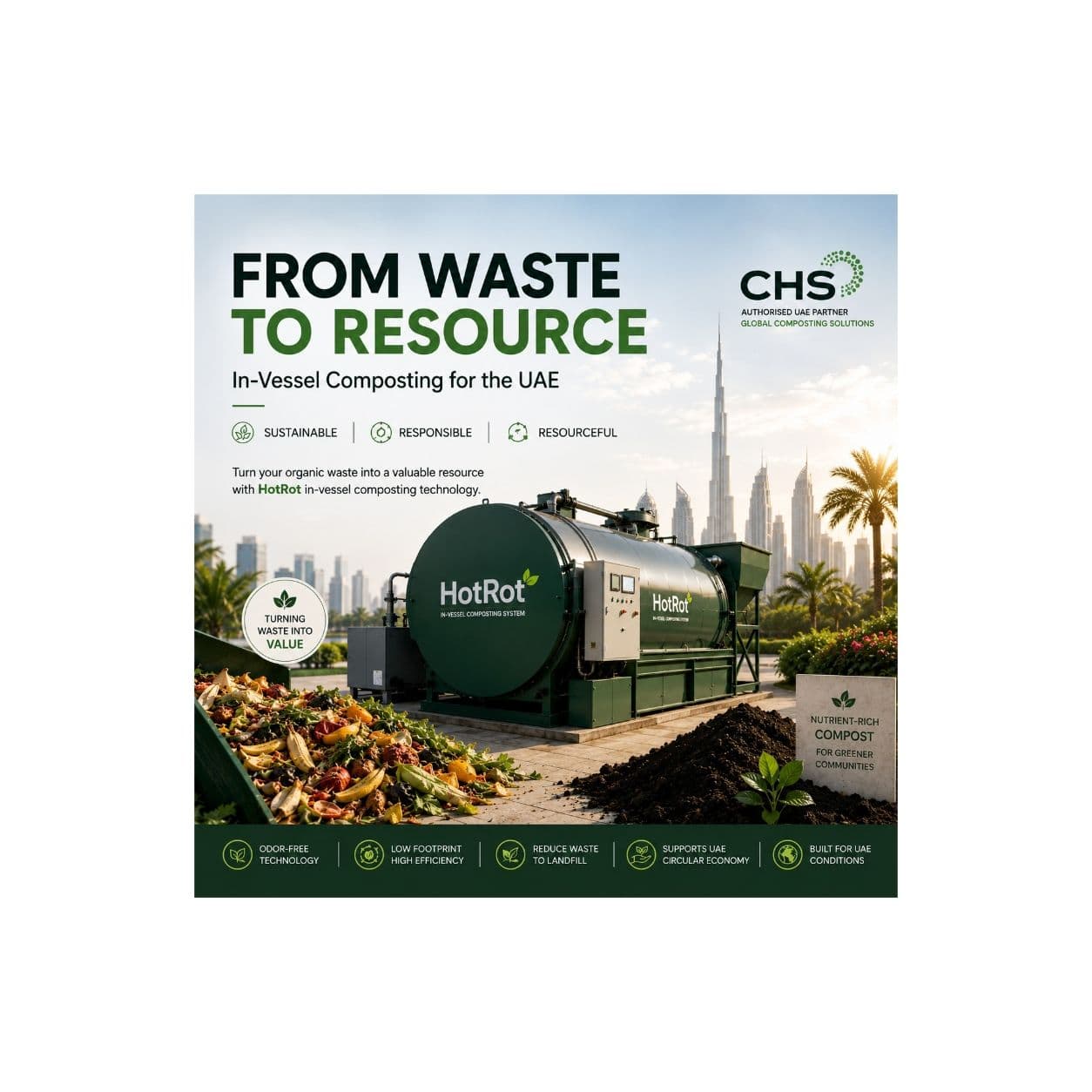
From Waste to Resource: In-Vessel Composting for the UAE
In-vessel composting is changing how UAE businesses handle organic waste - turning a daily disposal liability into a usable on-site resource. The UAE generates some of the highest food waste volumes per capita in the world, and with landfill diversion targets hardening into regulatory obligations under the UAE Circular Economy Policy, the question is no longer whether to act on organic waste. It is how, and where.
CHS is the authorized UAE partner for Global Composting Solutions, suppliers of the HotRot in-vessel composting system: a proven, odour-controlled technology that converts organic waste directly into usable compost on-site, without the land footprint, transport costs, or odour risks of conventional alternatives.
The UAE's Organic Waste Challenge
Across the UAE, hotels, food processors, municipalities, remote work camps, and sewage treatment plants are all generating organic waste that currently goes to landfill or travels long distances to off-site treatment facilities. Both routes carry significant cost - in tipping fees, transport logistics, and carbon emissions - and neither contributes to the circularity targets the UAE has formally committed to.
The UAE Circular Economy Policy sets a target of diverting 75% of waste from landfill by 2030. For hotels, resorts, food facilities, and industrial camps, on-site composting is one of the most direct ways to contribute to that target while cutting operational waste costs at the same time.
What Makes HotRot Different from Conventional Composting
Traditional open-windrow and tunnel composting require large land areas, generate odour complaints, and typically involve significant manual handling. HotRot takes a fundamentally different approach.
The HotRot system uses an insulated, enclosed vessel through which organic waste passes continuously. A central tine-bearing shaft rotates periodically to redistribute heat and moisture, maintain porosity, and ensure efficient aeration throughout the mass. The result is fast, consistent, odour-controlled composting in a fraction of the footprint of conventional systems.
Independent performance data shows HotRot installations operate at 25% lower annual running costs than a comparable tunnel composting facility. The enclosed design also requires 50 to 75% less physical space than similar-sized in-vessel and tunnel systems - a significant advantage in UAE industrial estates, hotel service yards, and remote camp settings where land cost and space availability are both constraints.
Global Composting Solutions provides a written guarantee of no objectionable odours beyond the site boundary for every HotRot system they design and install, provided it is operated to their guidelines. For UAE operators in hotel zones, urban areas, or environmentally sensitive locations, this contractual commitment is not a minor detail.
25% lower
annual operating costs versus a comparable tunnel composting facility
50-75% less space
required compared with similar-sized in-vessel and tunnel composting systems
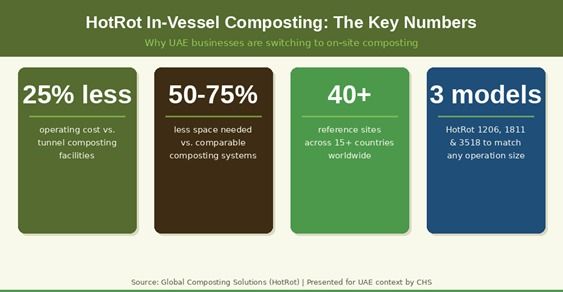
HotRot key performance figures for UAE composting operations. Source: Global Composting Solutions, adapted by CHS.
Which HotRot System Is Right for Your Operation?
HotRot comes in three models, each suited to different scales and applications:
- HotRot 1206: designed for canteens, commercial premises, and smaller hospitality operations. Processes 300 to 500 kg of organic waste per day. The right starting point for hotels, schools, and food businesses generating moderate waste volumes.
- HotRot 1811: suited to zoos, resorts, mining camps, oil and gas remote sites, and smaller municipal and wastewater transfer stations. Processes 1.8 to 2.5 tonnes per day with a feed hopper. Supports 24/7 unattended operation. 10-year design life.
- HotRot 3518: the largest unit, designed for municipal authorities and wastewater treatment plants serving up to 300,000 population equivalents. Processes 9 to 12 tonnes per day.
To illustrate: a 300-room Dubai beach resort typically generates 300 to 500 kg of food waste per day - exactly the throughput range of a single HotRot 1206. One unit handles the entire food waste stream on-site, with no transport contracts, no tipping fees, and no off-site disposal risk.
Named regional installations include Dubai Safari Park (HotRot 1811) and the Red Sea Development project in Saudi Arabia. The broader reference list spans remote work camps in West Africa, resorts in the Pacific, and municipal facilities in North America - 40+ installations across 15+ countries.
Not sure which model fits your facility? CHS can assess your waste volumes and recommend the right HotRot unit.
Contact CHS for a consultation ->
Why On-Site Composting Makes Sense for the UAE
HotRot units are already operating at ambient temperatures above 45 degrees C in the Middle East and below minus 25 degrees C in Canada. The insulated vessel maintains process temperatures independently of the external environment, giving UAE operators consistent year-round performance without seasonal variability.
Power consumption runs at 35 to 55 kWh per tonne of organic waste processed - approximately AED 16 to 25 per tonne at current DEWA commercial tariffs. That is a predictable operational cost, against which the saving on transport and off-site tipping fees can be directly compared.
On-site composting eliminates transport costs entirely. The compost produced can be used on hotel grounds, supplied to local farms, or donated to urban greening projects - supporting the UAE's food security agenda and Net Zero 2050 target by closing the resource loop at source rather than exporting the problem.
For remote oil and gas camps and mining operations, HotRot reduces the environmental liability of organic waste at isolated sites and cuts removal logistics costs - a meaningful saving across a multi-year project lifecycle.
Frequently Asked Questions
What types of organic waste can HotRot process?
HotRot handles a wide range of organic materials: food waste from kitchens and canteens, restaurant scraps, biosolids from sewage treatment, green waste, and mixed organic feedstocks from agricultural operations. The system can be configured to match specific waste streams and throughput volumes, making it adaptable to hotel operations, municipal facilities, and remote industrial sites alike.
How long does the in-vessel composting process take?
Waste moves through the HotRot vessel in approximately 10 to 12 days. Following the in-vessel stage, the output undergoes a maturation period of 2 to 4 weeks during which it stabilises before use. Operators should plan for compost storage space alongside the active vessel to accommodate this maturation phase.
Does the HotRot system produce odour?
Global Composting Solutions provides a written guarantee of no objectionable odours beyond the site boundary, provided the system is designed and installed by GCS and operated to their guidelines. Odours during the maturation and storage stages fall outside the scope of the guarantee. When those conditions are met, HotRot is a verifiably odour-safe solution for hotels, residential-adjacent facilities, and urban industrial zones.
What can the compost output be used for in the UAE?
The finished compost is a stable organic material suitable for landscaping, hotel grounds maintenance, urban greening initiatives, or supply to local farms. Directing the output into UAE agricultural use supports both the Circular Economy Policy and the food security goals set out under the national agenda - closing the loop between organic waste and productive land.
Ready to Turn Your Organic Waste into a Resource?
CHS supplies, installs, and commissions HotRot systems across the UAE. Whether you manage a hotel, a food processing facility, a remote camp, or a municipal waste stream, we can help you identify the right solution and get it operational.
For a sector-by-sector guide to which UAE operations benefit most from on-site composting, read our applications guide: On-Site Organic Waste Composting in the UAE: A Sector-by-Sector Guide
Speak to our team about your organic waste volumes and sustainability requirements.
Phone: +971 4 3232 523
Email: info@planetchs.com
Website: https://www.planetchs.com/contact-us