
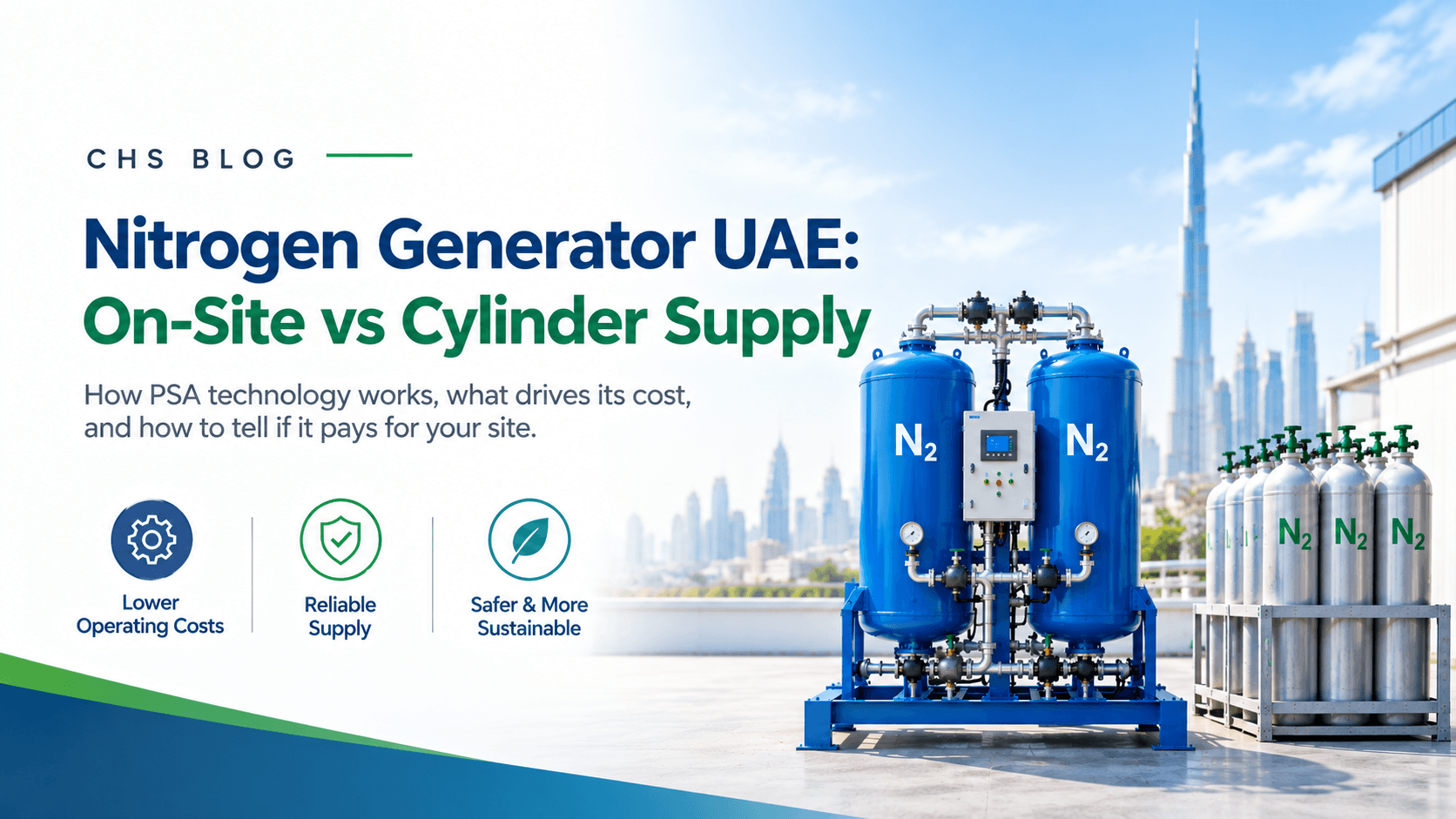
Nitrogen Generators in the UAE: When It Pays to Stop Buying Cylinders
On-site nitrogen generation is a conversation many UAE manufacturers are not having — because many are still buying cylinders or bulk liquid nitrogen without ever calculating what on-site generation would cost. The comparison is simple to run, and for many sites it is worth doing.
Nitrogen cylinders and bulk liquid deliveries are convenient. They require no capital expenditure, no installation, and no maintenance. But every cubic metre delivered carries the cost of production, compression, transport, cylinder management, and supplier margin. For a facility consuming meaningful volumes of nitrogen, those costs add up over a year, and it is worth knowing what the alternative would cost.
99.999%
Maximum nitrogen purity from a Hertz HNG generator — the level typically specified for laser cutting of stainless steel, electronics soldering, and pharmaceutical packaging. Most food packaging, pipeline purging, and fire suppression duties need less. Specifying purity per application, rather than defaulting to the maximum, is one of the biggest levers on both capital and running cost.
How PSA Nitrogen Generation Works
Atmospheric air contains approximately 78 percent nitrogen and 21 percent oxygen. A PSA (pressure swing adsorption) nitrogen generator passes compressed air through carbon molecular sieve vessels that preferentially adsorb oxygen, allowing nitrogen to pass through at high purity. The process runs continuously, cycling between two vessels so that one is always producing while the other regenerates.
The feed is your existing compressed air system. There is no cryogenic equipment, no specialist infrastructure, and no delivery scheduling — but the compressed air is not free, and it is where almost all of the running cost sits. A PSA generator needs more than one Nm³ of clean, dry compressed air for every Nm³ of nitrogen it delivers, and several times more at high purity. Most sites therefore need either genuine spare compressor capacity or an additional compressor sized for the nitrogen duty. CHS establishes which of the two applies during the site assessment, before any generator is quoted — a generator specified against a compressor that has no headroom will simply run the existing plant short of air.
Purity is adjustable from around 95 percent to 99.999 percent. The purity you specify directly affects generator size and running cost — specifying the correct purity for each application rather than defaulting to the highest available typically reduces both capital and operating cost.
Which UAE Applications Need On-Site Nitrogen
Modified atmosphere packaging (MAP) is one of the most common uses of nitrogen in food manufacturing. Nitrogen purging of food packaging extends shelf life by removing oxygen that promotes bacterial growth and oxidation. Snack foods, dairy products, roasted coffee, baked goods, and ready meals are common MAP applications, and all of them are produced in volume in the UAE. Most MAP duties are satisfied at 99.5 percent purity.
Laser cutting of stainless steel and aluminium uses nitrogen as an assist gas, blown coaxially with the laser beam to produce clean, oxide-free cut edges. This is a high-purity duty — typically 99.99 to 99.999 percent, since residual oxygen discolours the cut edge. For a metal fabrication shop running one or more laser cutters, on-site generation eliminates cylinder management and delivery scheduling entirely, and removes the dependency on timely cylinder supply in a market where logistics delays are not unknown.
Further UAE applications include pipeline purging and pressure testing in oil and gas construction, fire suppression system testing and maintenance, electronics manufacturing (nitrogen blanketing during soldering to prevent oxidation), and pharmaceutical packaging.
How to Compare On-Site Generation with Cylinder Supply
The comparison between cylinder supply and on-site generation needs four inputs: your nitrogen consumption in Nm³/month, the purity your process actually requires, your delivered cost per Nm³ from cylinders or bulk liquid, and the capital cost of an appropriately sized generator. Purity matters as much as volume, because it sets how much compressed air — and therefore how much electricity — each Nm³ of nitrogen costs to make.
Almost all of the running cost sits in the compressed air feed, so the calculation runs on your electricity tariff. In Dubai, a facility already using more than 10,000 kWh a month pays DEWA's top industrial rate of AED 0.380/kWh on every additional kWh, plus the fuel surcharge, which was AED 0.060/kWh in September 2026. Tariffs in Abu Dhabi and Sharjah differ from Dubai's.
Electricity is not the only running cost. Filtration consumables, preventive maintenance, and eventual carbon molecular sieve replacement all carry a charge.
Set that running cost against what you pay today per Nm³ for cylinders or bulk liquid, including rental and delivery. The gap, multiplied by your annual volume, is what pays back the generator.
At low volumes, on-site generation may not pay back inside a sensible horizon regardless of purity — the capital is too large relative to the volume it serves. CHS will say so rather than quote a generator that cannot be justified.
10×
The drop in output on the smallest Hertz HNG MOD generator between 95 and 99.999 percent purity: from 3 Nm³/h to 0.3 Nm³/h, on Hertz's published figures. Same machine, a tenth of the nitrogen. This is why CHS reviews purity application by application before sizing anything.
Buying nitrogen cylinders? CHS will calculate your on-site generation cost and payback from your current consumption data — at no charge.
What Determines the Right Generator Size and Purity
Purity specification drives generator size more than volume alone. Nitrogen at 99.5 percent purity for food packaging or fire suppression requires a smaller CMS bed than nitrogen at 99.999 percent for electronics or pharmaceutical applications. Specifying the correct purity for each application avoids over-engineering and reduces both capital cost and ongoing electricity consumption.
Flow rate — measured in Nm³/hour at the required purity and operating pressure — determines the generator frame size. For facilities with multiple applications at different purities, separate generators for each duty often deliver better overall economics than one generator sized to the highest required purity.
CHS sizes Hertz HNG systems from 0.3 Nm³/h on the smallest modular unit at 99.999 percent purity, up to approximately 3,450 Nm³/h on the largest standard unit at 95 percent purity. Because delivery falls as purity rises, sizing is always done against your specified purity, not flow alone.
UAE ambient conditions matter here too. PSA performance depends on the temperature and dryness of the feed air, so aftercooler and dryer performance in summer conditions directly affects what the generator actually delivers. CHS sizes against summer design conditions rather than nominal ratings, which is why a generator specified on a supplier's datasheet alone can underperform on a Dubai site in August.
Also relevant: Compressed Air Leaks in UAE Plants — a leaking compressed air system wastes nitrogen capacity as well as air. Fixing leaks before sizing a generator avoids over-specification.
FAQ: Nitrogen Generation for UAE Industry
Can a nitrogen generator work with any compressed air supply?
A PSA nitrogen generator requires clean, dry compressed air as its feed. The compressed air must meet minimum quality standards for particulates, oil, and pressure dewpoint. If your existing compressed air system meets that standard and has spare capacity, the HNG connects directly. If it needs upgrading — additional filtration, drying, or compressor capacity — CHS includes this in the site assessment, because it is part of the real cost of the installation.
What purity do I need for food packaging in the UAE?
Modified atmosphere packaging for most food products requires nitrogen at 99.5 percent purity or better. Some sensitive applications — fresh meat, premium coffee, certain dairy products — specify 99.9 percent or higher. The exact requirement depends on your product, packaging format, and target shelf life. The difference is not academic: the higher the purity, the more compressed air each Nm³ of nitrogen takes, and the less nitrogen the same generator delivers. CHS advises based on your production specification, and the Hertz HNG is adjustable across a range of purity targets from a single unit.
How does on-site generation compare to bulk liquid nitrogen delivery?
Bulk liquid nitrogen is stored at cryogenic temperatures and evaporated on demand. It offers very high purity — typically 99.999 percent or better — and becomes cost-effective at sufficiently high consumption volumes, because the cryogenic production cost per Nm³ falls with scale in a way that PSA generation does not. Broadly, the higher your purity requirement and the closer your demand is to continuous, the more bulk liquid competes. Below that crossover, PSA on-site generation is generally more cost-effective once the capital is amortised. CHS prepares a direct comparison for your specific volume and purity before recommending either route.
What happens if the nitrogen generator stops working?
Hertz HNG generators are designed for continuous operation with high reliability. For applications where nitrogen is a critical process input, CHS recommends specifying a cylinder backup supply that activates automatically on low generator pressure — a simple and low-cost precaution. The generator carries a standard warranty and is supported by CHS with preventive maintenance and emergency response across the UAE.
Ready to Compare the Numbers for Your Site?
CHS supplies and installs the Hertz HNG nitrogen generator range across the UAE. The starting point is a free consumption review — your current Nm³/month, purity requirement by application, existing compressor capacity, and cylinder cost — from which CHS produces a direct cost comparison and a payback calculation on your own tariff. No commitment required.
Get in Touch with CHS
- Phone: +971 4 3232 523
- Email: info@planetchs.com
- Website: planetchs.com/contact-us