
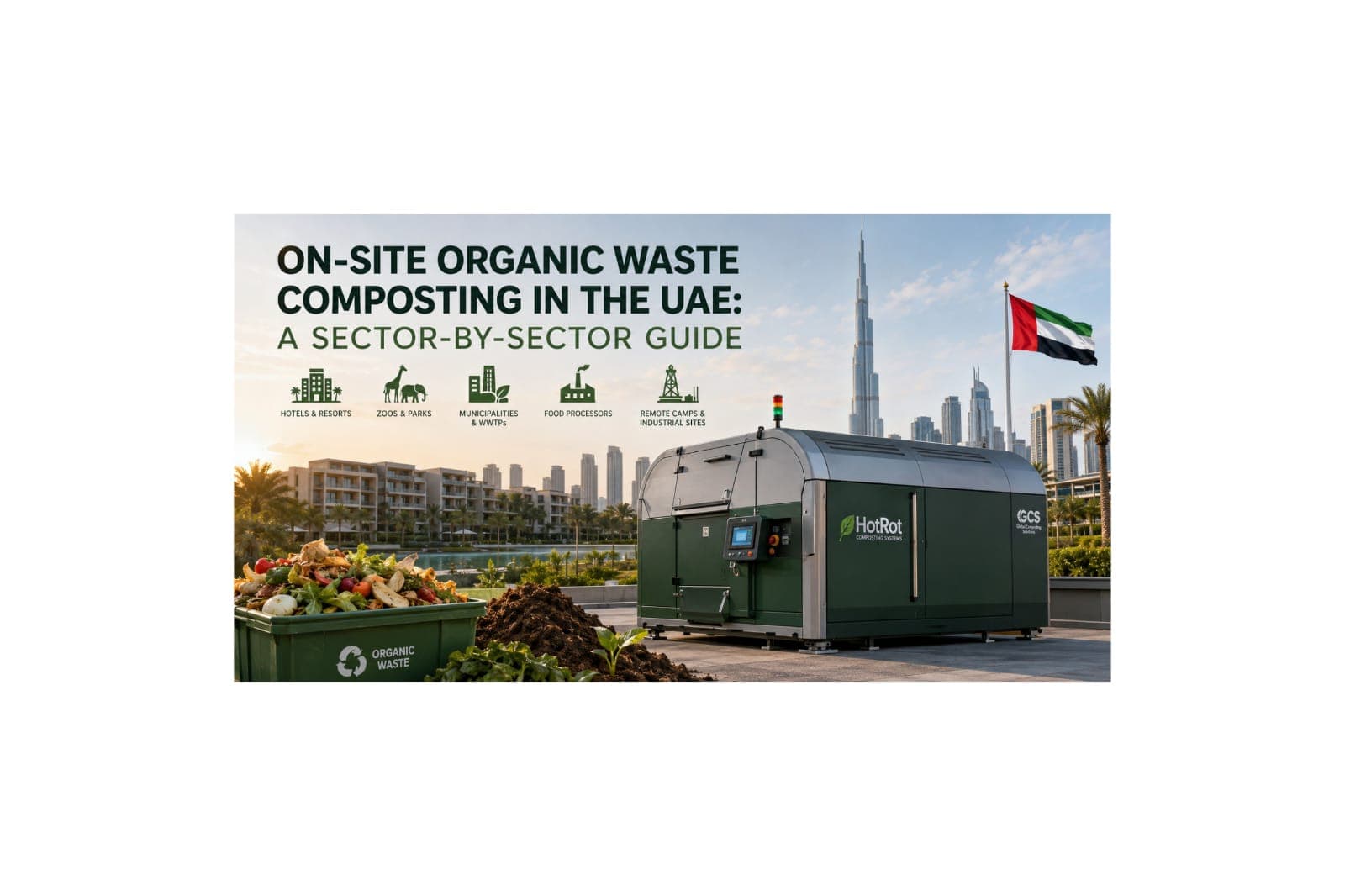
On-Site Organic Waste Composting in the UAE: A Sector-by-Sector Guide
Which UAE operations generate enough organic waste to justify on-site composting - and what does the right system look like?
On-site composting is not a one-size-fits-all decision - it is a sector-by-sector calculation. The UAE Circular Economy Policy targets 75 percent landfill diversion by 2030, and the operations that generate measurable organic waste daily are among the best positioned to contribute to that target while cutting disposal costs at the same time. The operations that benefit most from HotRot in-vessel composting share three things: daily organic waste at measurable volume, real and rising disposal costs, and a route to use or redistribute the compost produced. CHS supplies and installs HotRot systems for UAE and GCC operations across several sectors. What follows is a practical guide to identifying whether your operation is the right fit - and which system suits your waste volumes.
The UAE Operations That Benefit Most - and Why Sector Matters
Different sectors generate different waste streams at different volumes and in different operating environments. Sector determines the right HotRot model, the right pre-processing equipment, and the right arrangement for the compost output.
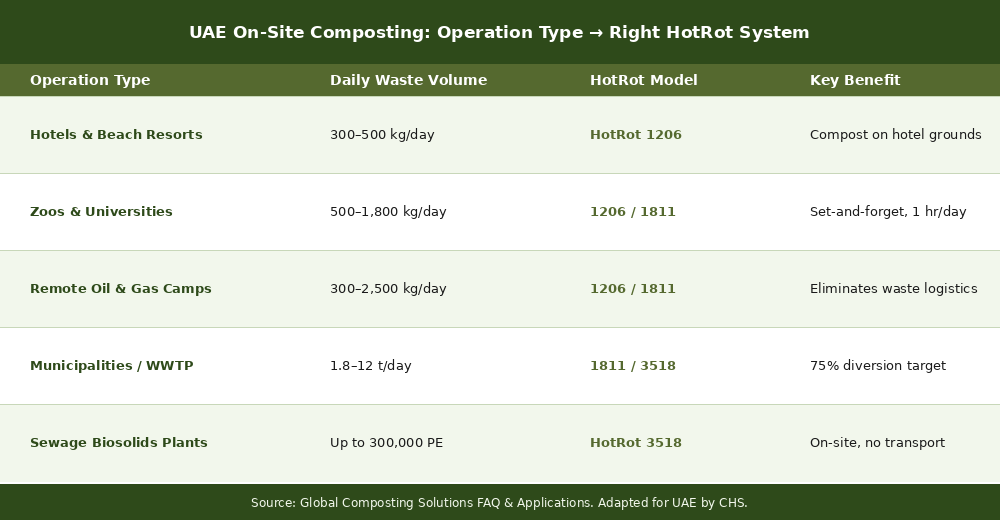
- Hotels and resorts: 300 to 500 kg of food waste per day per mid-size property. Compost used on-site or donated to urban greening. Odour-free guarantee essential in hotel zones.
- Zoos, universities, and large catering operations: 500 to 1,800 kg per day. Mixed food and green waste. Set-and-forget operation with approximately 1 hour per day of operator time.
- Municipalities and food processors: 1.8 to 12 tonnes per day. Source-separated food waste for populations of a few hundred to 130,000 people.
- Wastewater treatment plants: Biosolids composted on-site for WWTPs serving up to 300,000 population equivalents. Eliminates transport and off-site processing costs.
- Remote oil and gas camps and mining sites: 300 kg to 2.5 tonnes per day. Eliminates organic waste logistics from isolated sites. Control system designed for unattended operation.
Hotels, Resorts, and Zoos: Composting in Sensitive Environments
For UAE hospitality and tourism operations, on-site composting solves two problems simultaneously: waste disposal cost and sustainability reporting. A mid-size hotel generates 300 to 500 kg of food waste per day - exactly the throughput range of a HotRot 1206. The compost produced can be used directly on hotel grounds, donated to urban greening initiatives, or redirected to local agricultural use.
The critical factor for hotels, resorts, and wildlife parks is odour control. Properties in urban hotel zones or beach frontages cannot risk an odour complaint from guests or neighbours. Global Composting Solutions is the only commercial composting manufacturer to offer a written contractual guarantee of no objectionable odours beyond the site boundary, provided the system is installed and operated to GCS guidelines. Dubai Safari Park operates a HotRot 1811 on that basis.
Day-to-day operation requires approximately 1 hour of operator time. The touchscreen control system can be accessed by engineering teams via laptop or smartphone, making it practical for sites already managing multiple building systems.
Municipalities, WWTPs, and Food Processors: Composting at Scale
For municipal waste operators and wastewater treatment plants, the HotRot 3518 and 1811 provide on-site capacity that eliminates the cost and carbon footprint of transporting organic waste to off-site facilities. The 3518 processes 9 to 12 tonnes per day and is designed for WWTPs serving up to 300,000 population equivalents - turning dewatered biosolids into usable fertiliser on-site.
For source-separated food waste, HotRot can serve municipal populations from a few hundred to 130,000 people. Multiple units can be installed in parallel to scale with growing volumes. A critical point: quality compost requires quality inputs. Source separation must be built into the collection model before the composting system is commissioned.
Not sure which model and configuration suits your operation? CHS can assess your waste volumes and recommend the right system.
Contact CHS for a consultation ->
Remote Camps and Industrial Sites: Eliminating the Waste Logistics Problem
Remote oil and gas camps and mining operations face a specific organic waste challenge: accumulation at isolated sites, expensive removal logistics, and environmental liability that compounds over a multi-year project lifecycle. HotRot systems have been deployed at remote work camps in Northern Canada, West Africa, Asia, and the Pacific - the same capability applies directly to GCC operations.
The 1811 and 1206 handle between 300 kg and 2.5 tonnes per day depending on configuration. Where green waste or woody bulking material is limited - as it typically is at remote desert sites - GCS can supply integrated dewatering systems that reduce the amount of bulker required. Remote monitoring is standard, and the process runs automatically between feeds, requiring minimal intervention from site personnel.
Frequently Asked Questions
What types of organic waste can UAE hotel and catering kitchens put through a HotRot?
HotRot handles kitchen waste including plate scraps, food preparation waste, spoiled food, compostable packaging, and paper napkins. Food waste can be processed without shredding, simplifying the kitchen workflow. Grass clippings, garden waste, and animal manures can be added as balancing materials. Plastics, glass, metals, and large hard bones should not enter the system.
How much operator time does a HotRot installation actually require?
The HotRot vessel itself requires under an hour a day for a single unit, primarily for feeding and monitoring. Additional time may be needed for waste preparation and compost handling depending on the waste stream and intended use of the output. Day-to-day composting is designed to be set-and-forget.
Is HotRot a single machine or a full system?
HotRot is an integrated system, not a single machine. Global Composting Solutions designs the full solution for each client - from waste reception through pre-processing, the composting vessel, and final product handling. CHS delivers and commissions the complete system for UAE and GCC sites.
Can multiple HotRot units be installed to handle higher waste volumes?
Yes. Multiple units can operate in parallel, allowing HotRot to scale with growing waste volumes or to provide redundancy for continuous-operation facilities. CHS can specify the right number and model of units for your site based on projected waste volumes.
Ready to Identify the Right HotRot System for Your Operation?
CHS supplies, installs, and commissions HotRot systems across the UAE and GCC. Whether you manage a hotel, a municipal programme, a wastewater plant, or a remote industrial site, we can assess your waste volumes, identify the right configuration, and manage the installation from first assessment to commissioning.
Want to understand how HotRot works? Read our guide to in-vessel composting for the UAE.
Speak to our team about your waste volumes and composting requirements.
Get in Touch with CHS
Phone: +971 4 3232 523
Email: info@planetchs.com
Website: https://www.planetchs.com/contact-us