
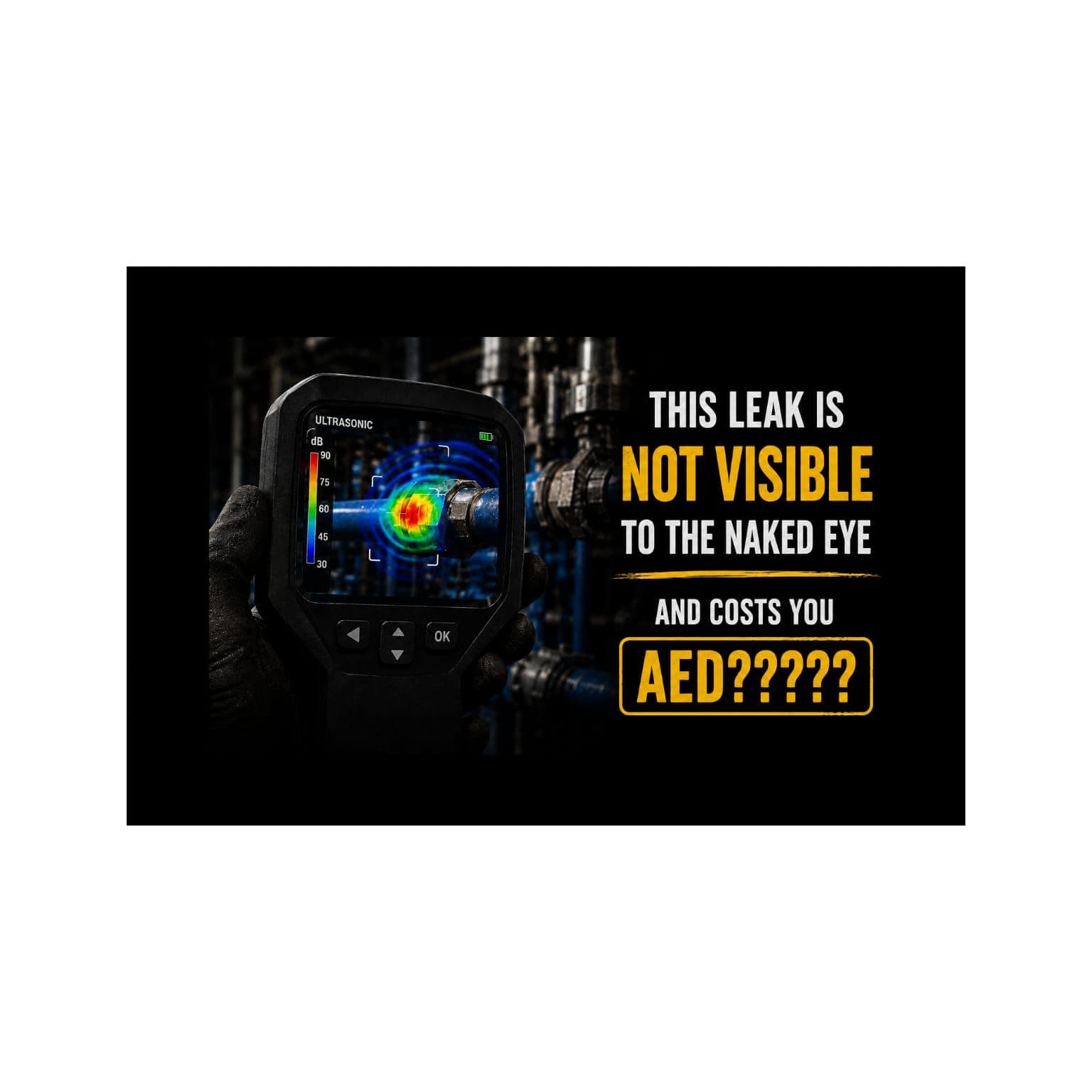
The Hidden Cost of Air Leaks in Compressed Air Systems
How a 3mm hole could be costing your facility over AED 20,000 a year, and why most UAE plants don’t know it yet.
Walk the floor of almost any manufacturing plant in the UAE and you’ll hear it: a faint hiss near a pipe joint, a subtle pressure fluctuation on the gauge, a compressor that never quite seems to rest. These are the tell-tale signs of air leaks, and they’re costing UAE industry far more than most facility managers realise.
Compressed air is often described as the “fourth utility”, sitting alongside electricity, water, and gas. But unlike the others, it’s uniquely vulnerable to invisible waste. And in an environment like the UAE, where plants run year-round, ambient temperatures regularly exceed 45°C, and energy costs are a constant boardroom conversation, the financial impact of doing nothing adds up fast.
What Exactly Is an Air Leak?
Air leaks are unintended escapes of compressed air from the distribution system, through worn seals, loose fittings, corroded joints, or damaged hoses. They’re silent under normal plant noise, invisible to the naked eye, and for that reason, they’re routinely ignored until something more dramatic forces a shutdown.
The most common leak points in industrial systems are:
- Threaded pipe joints and compression fittings
- Valves, flanges, and quick-release couplings
- Filter-regulator-lubricator (FRL) units
- Rubber hoses and flexible connections
- Condensate drain valves
None of these are dramatic on their own. But across an entire facility, they compound, and the combined loss can be staggering.
The Numbers That Should Get Your Attention
Here’s where the conversation usually shifts from “interesting” to “urgent.”
Research from Hertz Kompressoren, one of Europe’s leading compressor manufacturers and a CHS partner, puts typical leakage rates in industrial facilities at 20–40% of total compressed air output. Many plants we audit in the UAE sit at the higher end of that range, with leakage rates between 25–35% going undetected for years.
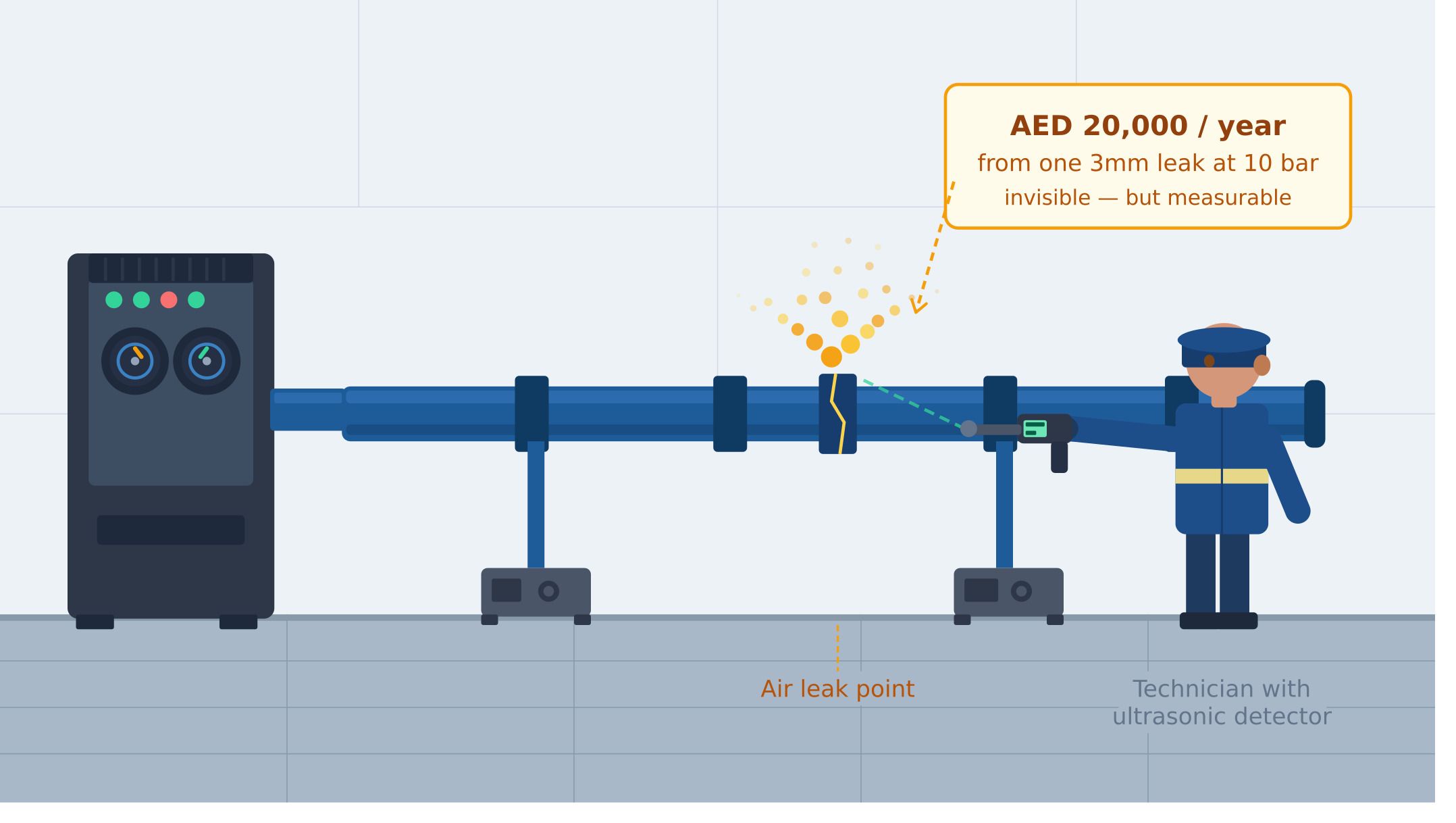
To put that in concrete terms: a small 3mm diameter leak at 10 bar in UAE conditions loses approximately 45,000 kWh of electricity per year. At current UAE tariff rates, that’s roughly AED 20,000 annually — from a hole smaller than a pencil eraser.
A 25% reduction in leakage across a typical mid-sized plant can save over 1,040,000 units of electricity annually. That’s not a rounding error. It’s a serious line item on your energy budget.
And that figure doesn’t account for the secondary costs: compressors running hotter, maintenance cycles shortening, production pressure dropping at peak demand.
Why UAE Conditions Make This Worse
Most compressed air efficiency data is benchmarked for temperate European conditions: ambient temperatures of 15–20°C, moderate humidity, seasonal shutdowns. The UAE is a fundamentally different operating environment.
In a Jebel Ali packaging facility we audited last year, the compressor room regularly reached 52°C during summer months. The machines were running at full capacity not because production demand was high, but because air leaks meant the system could never hold pressure, so the compressors never stopped cycling. The client had assumed it was a capacity issue and was planning to purchase an additional unit. The actual fix cost a fraction of that.
The UAE context amplifies leak losses in three specific ways:
- Higher ambient temperatures reduce compressor efficiency, meaning every unit of lost air is replaced at greater energy cost
- Continuous year-round operations (typically 8,000+ hours) mean small daily losses compound into massive annual figures
- Rapid thermal cycling in environments with aggressive air conditioning causes fittings and seals to expand and contract, accelerating wear
For industries like pharmaceuticals, food and beverage, and precision fabrication, where compressed air quality and pressure stability are non-negotiable, leaks aren’t just an energy problem. They’re a production risk.
How Leaks Are Detected (and Why Basic Methods Fall Short)
The traditional approach is soap bubble testing, applying a solution to joints and looking for bubbles. It works, but it’s slow, requires a quiet plant, and misses small leaks in hard-to-reach areas. In a busy 24/7 facility, it’s rarely practical.
The standard for leak detection in a serious audit is ultrasonic acoustic detection. Ultrasonic leak detectors pick up the high-frequency sound of compressed air escaping through a gap. This sound sits above the range of normal industrial noise. A trained technician can walk an entire plant floor, identify every significant leak point, and quantify the loss, all without stopping production.
When combined with system data logging, tracking compressor runtime, pressure differentials, and flow patterns over time, the audit gives you a complete picture: not just where the leaks are, but how much they’ve been costing you, and what pressure optimisation opportunities exist beyond the obvious fixes.
Want to know how much air leaks are costing your facility right now? Contact the CHS team for a professional compressed air audit. Most clients recover the audit cost within the first month of fixes. Call +971 4 3232 523 or email info@planetchs.com.
What the Return on Investment Actually Looks Like
Leak detection and repair is one of the highest-ROI activities available in industrial energy management. The numbers consistently hold across industries and facility sizes:
- Facilities that reduce leakage by 25% typically cut total compressed air energy consumption by 5–15%
- Payback on a leak detection and repair programme typically runs 6–24 months, depending on facility size and leak severity
- Equipment life extends because compressors run fewer hours and at lower temperatures
- Maintenance intervals lengthen as pressure becomes more stable and components experience less stress
In the Jebel Ali facility mentioned above, the client avoided a capital purchase of an additional compressor, a saving of over AED 200,000, by instead investing in a structured leak detection and repair programme. The system is now running comfortably within capacity.
The CHS Approach: Audit First, Fix Right
CHS doesn’t start with a sales conversation — we start with an honest assessment of what’s actually happening in your system. That means a structured compressed air audit covering:
- Ultrasonic leak detection across all distribution points
- Compressor performance analysis and duty cycle review
- Pressure drop mapping from generation to point of use
- System data logging and loss quantification
- Recommendations for leak repair, pressure optimisation, and longer-term upgrades (including VSD compressors where appropriate)
We then work with your maintenance team to address the findings in a priority order that makes commercial sense: highest-impact leaks first, with a clear ROI case for each stage. And we don’t disappear after the report. Our preventive maintenance programmes ensure leaks don’t simply return six months later.
CHS is an authorised partner for Hertz Kompressoren in the UAE, which means we have direct access to technical documentation, engineering support, and genuine replacement components. When we recommend a solution, it’s based on the same data the manufacturer uses.
The Cost of Waiting
The frustrating reality of air leaks is that they’re invisible, so they rarely create an emergency. A bearing failure shuts a line down. A leak just silently drains your energy budget, month after month, until someone decides to look.
For a facility running 8,000 hours a year with a 30% leakage rate, every month without action is another month of avoidable cost. The technology to find and fix these losses exists. The ROI case is clear. The only variable is when you decide to start.
Get in Touch with CHS
CHS Creative Engineering provides professional compressed air audits, leak detection programmes, and long-term optimisation solutions for industrial facilities across the UAE.
Phone: +971 4 3232 523
Email: info@planetchs.com
Website: https://www.planetchs.com/contact-us
To discuss a compressed air audit for your facility, contact us today.