
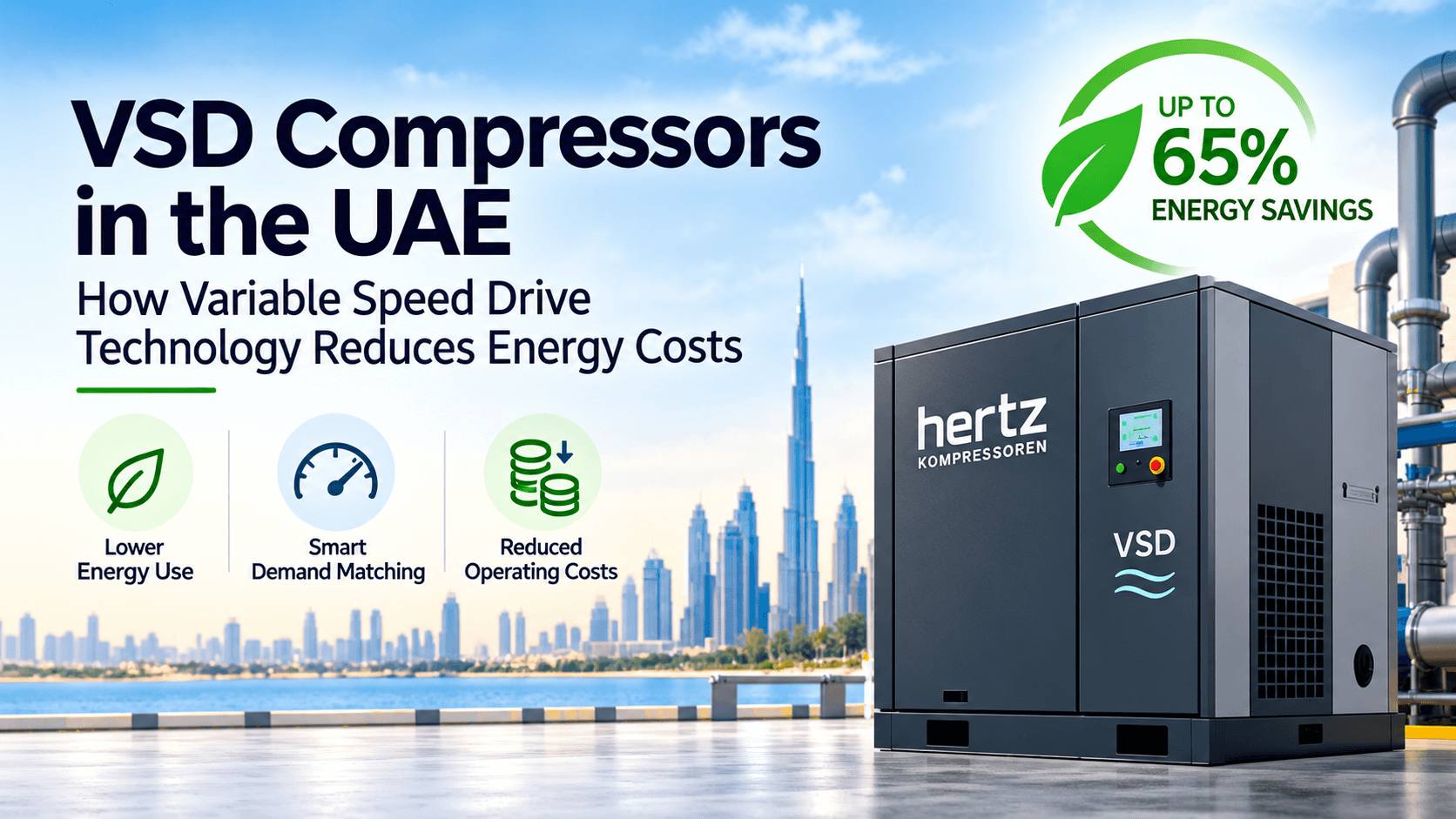
VSD Compressors in the UAE: How Variable Speed Drive Technology Reduces Energy Costs
Hertz Kompressoren manufactures both fixed-speed and Variable Speed Drive (VSD) compressors, and CHS supplies and services both across the UAE. Each has its place. A fixed-speed machine is robust, well understood, and the right choice for applications that run at consistently high demand around the clock. A VSD machine is the right choice when demand varies - and in many UAE facilities, it varies more than facility managers realise.
VSD technology adjusts the motor speed continuously to match actual compressed air demand in real time. When less air is needed, the motor slows and power consumption falls proportionally. When demand rises, the motor speeds up to match. The compressor is always producing at the level the facility requires, rather than running at a fixed output and managing the difference through pressure band cycling.
The energy saving that results depends on how much demand varies across the operating cycle. For facilities with significant variability, the saving is substantial. Hertz Kompressoren's own data puts the maximum energy saving at up to 65% versus a fixed-speed equivalent running the same duty with high variability. For facilities with lower variability, the saving is proportionally smaller. CHS works out the site-specific figure as part of a compressed air audit before recommending either technology.
65%
max energy savings with VSD vs fixed-speed on variable demand. Source: Hertz Kompressoren
90%
of compressor energy recoverable as heat with heat recovery option. Source: Hertz Kompressoren
Why Choosing the Right Compressor Type Matters More in the UAE
The case for matching compressor technology to your demand profile is strong anywhere. In the UAE, it is particularly important, for two reasons.
First, UAE plants run longer hours. Most industrial facilities in Dubai, Abu Dhabi, and Sharjah operate 8,000 hours per year or more, with few seasonal shutdowns. The difference between a compressor running at the right output for your demand and one running at a fixed output regardless of demand compounds across those hours into a significant annual energy figure.
Second, demand variability in UAE facilities is often more pronounced than the nameplate figure suggests. A packaging line running two shifts five days a week has very different demand at 2am on a Friday compared to 10am on a Tuesday. A food processing plant has high-demand periods tied to production runs and quiet periods during changeovers and overnight. A fabrication shop running laser cutters and pneumatic tools simultaneously has demand that fluctuates sharply depending on what is on the production schedule.
For facilities with demand profiles like these, a VSD compressor tracks the variation automatically and delivers the energy saving that comes with it. For a facility running at near-constant, consistently high demand, a fixed-speed machine continues to be a straightforward and reliable choice. The starting point is always understanding what your demand actually looks like across a full operating cycle — and continuous monitoring is the most reliable way to establish that.
Fixed-Speed and VSD: How Each Technology Works
The table below describes how each compressor type handles common operating conditions. Neither column represents a better or worse machine overall. The right choice depends on your demand profile.
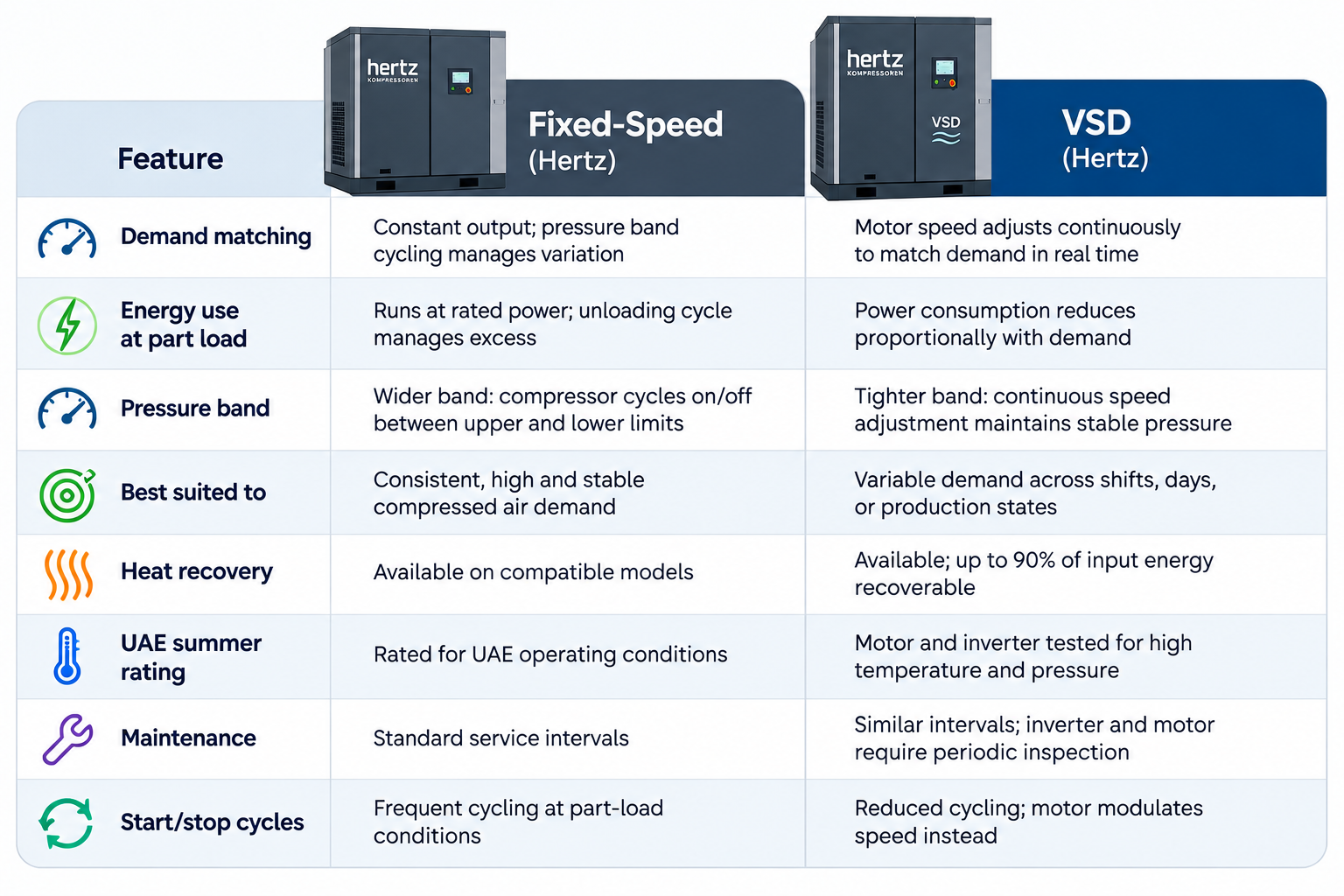
The pressure stability point is relevant for UAE facilities running sensitive processes. Because a VSD compressor adjusts speed continuously rather than cycling on and off between pressure limits, the pressure band at the point of use is tighter. For pharmaceutical, food-grade, or precision fabrication applications where process conditions affect product quality, that stability can matter. For general industrial applications, the difference is less significant.
The Hertz VSD Range
Hertz Kompressoren's VSD compressor range is designed for variable demand applications from the ground up. Key features relevant to UAE operations:
Motor and inverter matched to application. The VSD motor and inverter are designed together with the compression element to deliver maximum efficiency across the full speed range, from minimum to maximum output. Efficiency is maintained at part load, not just at nameplate conditions.
High-temperature testing. Hertz VSD motors and inverters have been tested in high-temperature, high-pressure environments. In UAE compressor rooms that regularly exceed 45 degrees Celsius during summer months, this means the machine performs as rated rather than derating under heat load.
Stable pressure delivery. Continuous speed adjustment keeps system pressure within a tighter band than pressure band cycling, which benefits sensitive downstream applications.
Reduced vibration. VSD compressors produce less vibration across the operating range, which reduces noise in the compressor room and can extend the life of pipework connections and fittings.
No unloading cycle. When demand drops, the VSD motor slows to match rather than running unloaded. For facilities where demand frequently dips to low levels, this eliminates the energy cost of unloaded running entirely.
Not sure whether VSD or fixed-speed is right for your facility? CHS provides free site assessments that include a demand profile review. We give you the energy saving calculation for your actual operating conditions and tariff before you commit to either option.
Call +971 4 3232 523 or email info@planetchs.com
Heat Recovery: An Option on Both Technologies
Up to 90% of the electrical energy input to a compressor is released as heat during the compression process. With a suitable heat recovery option, a significant portion of that heat can be captured and redirected rather than expelled to atmosphere through the cooling system.
Hertz compressors, including both fixed-speed and VSD models, are available with heat recovery compatibility. The most common applications in UAE facilities are preheating process water, supporting industrial washing and cleaning systems, and supplementing hot water supply for welfare or canteen areas. In cooler months, recovered heat can also supplement space heating in adjacent offices or production areas. For more on how cooling and heat management affect compressor selection in UAE conditions, see our Water-Cooled Compressors post.
A 110 kW compressor running at full load rejects approximately 90-95 kW of recoverable heat. Over an 8,000-hour operating year, that is a substantial thermal resource. For facilities with a hot water or thermal load currently supplied by electricity or LPG, heat recovery reduces that draw and the saving shows on the utility bill. CHS advises on heat recovery options as part of any compressor assessment.
What the Energy Saving Looks Like in Practice
The energy saving from VSD technology depends on how much compressed air demand varies across the operating cycle. The worked example below uses a facility with moderate variability, which is representative of many UAE packaging, food processing, and fabrication operations.
A 132 kW compressor running 8,000 hours per year at an average load factor of 70% consumes approximately 739,200 kWh annually on a fixed-speed machine. The same duty on a Hertz VSD compressor, with energy savings of 35% reflecting moderate demand variability, would consume approximately 480,480 kWh. At the DEWA working rate of AED 0.44/kWh (September 2026), that difference is AED 113,837 per year.
AED 113k+
estimated annual saving - 132 kW, 70% load, 8,000 hrs/yr, 35% VSD saving, DEWA AED 0.44/kWh (Sep 2026)
These are indicative figures for a facility with moderate demand variability. A facility with higher variability will see a larger saving. A facility running at near-constant full demand will see a smaller saving, and in that case a fixed-speed machine may remain the more cost-effective choice. Payback period depends on your specific demand profile, operating hours, and current equipment age. CHS works out the site-specific calculation using your actual demand profile and your tariff (Abu Dhabi and Sharjah tariffs differ from Dubai's) before making any recommendation.
Which Applications Suit VSD Technology
VSD technology delivers its best return in applications where compressed air demand varies significantly across the day or week. The more variable the demand, the greater the saving relative to a fixed-speed machine running the same duty.
Applications that typically suit VSD well: Food and beverage plants with batch production cycles. Packaging operations with variable line speeds. Metal fabrication shops where pneumatic tools and laser cutters run intermittently. Pharmaceutical manufacturers with variable production schedules and high air quality requirements. Hotels and large commercial facilities with fluctuating demand across the day. Any facility where overnight or weekend demand is substantially lower than peak production hours — a gap that often reveals significant air losses when measured for the first time.
Applications where fixed-speed remains a strong choice: Continuous process industries running at near-constant demand around the clock. Facilities with a predictable, stable air requirement that does not vary significantly between shifts. Operations where simplicity and ease of maintenance are the primary considerations alongside capital cost.
CHS supplies and services both technologies. When we assess a facility, we recommend the option that gives the best return for that specific application, not the one that happens to have a higher unit price. If the numbers favour fixed-speed, we say so.
FAQ: VSD Compressors for UAE Facilities
Can a VSD compressor be installed alongside an existing fixed-speed machine?
Yes, and this is a common configuration in larger UAE facilities. A fixed-speed machine handles the base load while a VSD unit handles the variable portion of demand. The VSD modulates to cover fluctuations while the fixed-speed machine runs steadily at its optimum point. CHS designs and commissions multi-compressor configurations of this kind, including sequencing controls that decide which machine runs and when based on real-time demand.
Does a VSD compressor require different maintenance?
The core maintenance schedule for a Hertz VSD compressor is similar to a fixed-speed equivalent: oil and filter changes, air/oil separator service, cooler cleaning, and drive component inspection. The inverter and variable speed motor require periodic inspection in addition to standard compressor maintenance tasks. CHS's service and maintenance programmes cover Hertz VSD and fixed-speed installations across the UAE, and we can tailor a maintenance plan to either machine type.
How long does a VSD installation take?
A straightforward replacement installation typically takes one to two days, depending on machine size and the existing pipework configuration. CHS schedules installations to minimise production disruption, working around shift patterns or planned maintenance windows where possible. For larger projects or those requiring significant electrical or pipework modifications, the schedule is confirmed after the site assessment.
What happens if I have a mixed fleet - some fixed-speed, some VSD?
Mixed fleets are common and work well when sequenced correctly. CHS installs compressor management systems that sequence across fixed-speed and VSD machines, running each at its most efficient point based on current demand. If you have CS Instruments monitoring already in place, performance data from all machines can be fed to the same dashboard regardless of type, giving a single view of the whole compressed air system. For more on how monitoring works in UAE facilities, see our Smart Monitoring post.
Find Out Which Compressor Technology Is Right for Your Facility
CHS is the UAE partner for Hertz Kompressoren, supplying and servicing both fixed-speed and VSD compressors for industrial facilities across Dubai, Abu Dhabi, Sharjah, and the wider UAE. The starting point is a free site assessment. We review your demand profile, run the energy calculation on your actual tariff, and give you an honest recommendation on which technology suits your application.
If you are not sure whether your current system is matched to your demand, that assessment will tell you.
Phone: +971 4 3232 523
Email: info@planetchs.com
Website: planetchs.com/contact-us