
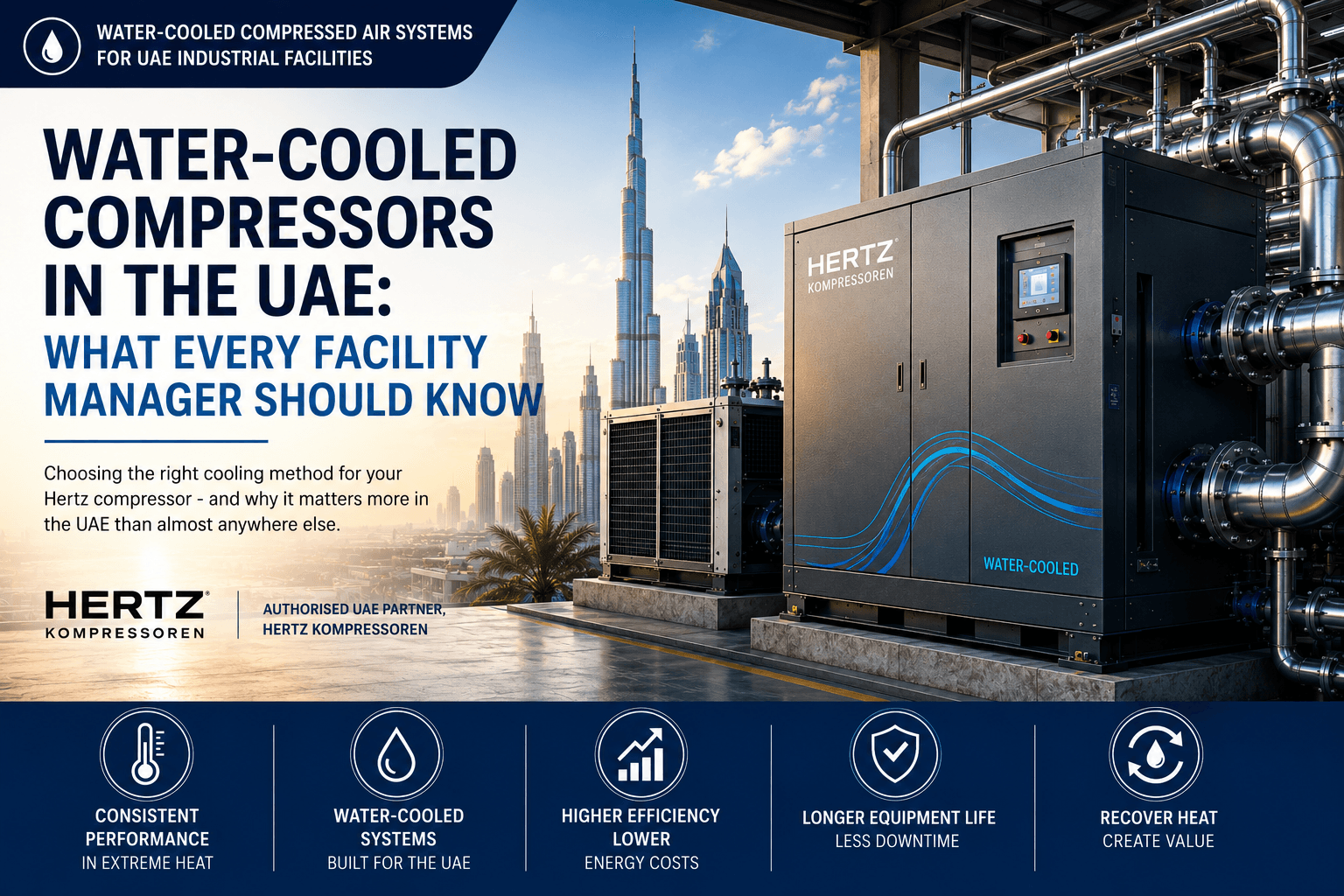
Water-Cooled Compressors in the UAE: What Every Facility Manager Should Know
Water-cooled compressors deliver a significant performance advantage for UAE industrial facilities. While air-cooled units work by dissipating heat into the surrounding air, their efficiency drops sharply when ambient temperatures exceed 40 degrees Celsius - a routine condition across the Emirates for four to five months of the year.
Water-cooled systems bypass this limitation entirely. They transfer heat to a water circuit rather than the surrounding air, maintaining consistent performance regardless of what is happening outside. For UAE manufacturers, this is not a minor technical detail. It is a practical difference in output, energy cost, and equipment lifespan.
Why Cooling is Critical in a UAE Compressor Installation
Up to 90% of the mechanical energy consumed during the compression process converts directly into heat. That heat must be removed from the system effectively, or compressed air quality drops, components wear faster, and energy consumption climbs.
- Up to 90% of mechanical energy consumed in compression becomes heat - making the cooling system one of the most important components in any compressor installation
In a temperate climate, air-cooled systems handle this adequately. In a UAE summer, they are fighting the ambient conditions every hour of operation. A compressor room in Dubai or Abu Dhabi in July can reach 50 degrees Celsius. At that temperature, air cooling becomes a significant source of inefficiency, thermal stress accelerates bearing and seal wear, and unplanned downtime becomes a practical risk - not a theoretical one.
The Three Types of Water-Cooled Compressor Systems
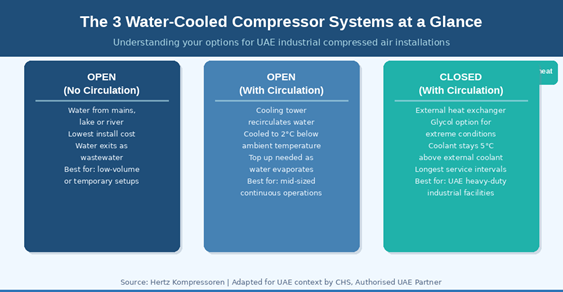
Water-cooled systems for industrial compressors fall into three categories. Understanding the differences helps UAE facility managers choose the right configuration for their site.
- Open system (no circulation): Cooling water from an external supply - mains, a storage tank, or a local water source - passes through the compressor once and exits as wastewater. Installation cost is low and the setup is straightforward, but ongoing water consumption is high. For UAE operations, incoming water purity must be assessed carefully, and proper filtration is essential to prevent blockages and protect heat exchanger components.
- Open system (with circulation): Cooling water is recirculated through an external cooling tower, where it releases heat and drops to approximately 2 degrees Celsius below ambient temperature before returning to the compressor. Water evaporated in the tower is replenished from an external supply. This system suits medium to large continuous operations but requires monitoring for water quality deterioration over time.
- Closed system (with circulation): The coolant circulates in a sealed loop through an external heat exchanger, either air-cooled by a fan or water-cooled by a secondary circuit. The coolant is maintained at around 5 degrees Celsius above the external coolant temperature before re-entering the compressor. Closed systems carry the longest service intervals and lowest maintenance costs, and can incorporate glycol for temperature extremes. For high-demand UAE industrial applications, this is generally the configuration that offers the best long-term total cost of ownership.
Not sure which cooling configuration suits your facility? CHS can assess your site and recommend the right Hertz compressor setup.
Contact CHS for a system consultation ->
Which System Is Right for Your UAE Facility?
The right choice depends on your facility's water availability, operating hours, ambient conditions, and maintenance capacity. As a general guide for UAE industrial sites:
- High ambient heat and continuous operation: closed systems are the preferred specification. The sealed loop eliminates contamination risk, and the reduced maintenance frequency suits facilities running 24/7.
- Moderate throughput with access to a cooling tower: open circulation systems are a proven and cost-effective option, provided water quality is monitored and filtration is maintained.
- Lower duty cycles or temporary installations: open non-circulation systems offer the simplest setup, though water consumption and wastewater handling need to be factored into the operational plan.
The Hertz IMPETUS series - from 22 to 315 kW - is the primary water-cooled range CHS specifies for UAE facilities. Purpose-engineered plate-type and tubular-type heat exchangers deliver high energy efficiency with minimal pressure loss, with materials selected for corrosion resistance against the coolant used.
Recovering the Heat: Turning a Cost into a Benefit
Because compression generates so much heat, water-cooled systems also create a heat recovery opportunity that air-cooled installations cannot offer. The warmed water circuit can be directed to pre-heat process water, supply hot water for facility use, or support space heating in cooler months.
For UAE facilities running large compressors continuously, this is worth quantifying at the design stage. A compressor drawing 100 kW of electrical input generates roughly 80 to 90 kW of recoverable heat energy. Redirecting even a portion of that into a productive process reduces overall energy spend and supports facility sustainability targets.
At current DEWA commercial tariffs, recovering 60-80 kW of heat from a system running 8,000 hours per year reduces purchased energy costs by approximately AED 211,200 to AED 282,000 per year.
In July 2026, a Hertz Impetus VSD 200 supplied and installed by CHS was witness-tested at a UAE ceramics production plant — a demanding environment of high ambient heat and heavy ceramic dust. The 200 kW machine delivered a steady 1,572 cfm at 6.1 bar throughout the test, drawing an average of just 128 kW — well under half its rated full-load power — with no alarms or pressure drops even as compressed-air temperatures reached 55°C on-site. The test, witnessed by ten representatives from both companies, confirmed the performance commitments CHS made at the specification stage.
Frequently Asked Questions
What is the main difference between water-cooled and air-cooled compressors?
Air-cooled compressors dissipate heat into the surrounding air, which makes them efficient in moderate climates but progressively less effective as ambient temperatures rise. Water-cooled compressors transfer heat to a water circuit, maintaining consistent performance regardless of the ambient temperature. In UAE conditions - where compressor rooms regularly exceed 45 degrees Celsius in summer - water cooling is the engineering standard for continuous-duty industrial installations.
Which water-cooled system type is best suited to a UAE industrial facility?
For most high-demand UAE applications, closed-loop systems offer the best overall value. The sealed circuit prevents contamination from external water sources, requires the least maintenance intervention, and performs reliably in 24/7 operations. Open circulation systems using a cooling tower are a well-proven option for medium-scale operations where a cooling tower can be incorporated into the site design. CHS can assess your specific duty requirements, water availability, and space constraints and recommend accordingly.
What is heat recovery and is it worth considering for a UAE facility?
Heat recovery captures the thermal energy generated during compression - up to 90% of mechanical energy - and redirects it to a useful purpose such as process water heating or facility hot water supply. For facilities running large compressors continuously, the recoverable energy is significant. CHS designs heat recovery into compressor installations at the specification stage, so the system is configured to capture that energy from day one rather than retrofitted later at greater cost.
Can an existing air-cooled Hertz compressor be converted to water cooling?
In most cases, no - the cooling architecture is integral to the compressor design and cannot be changed after manufacture. However, if your current air-cooled unit is underperforming in UAE summer conditions, CHS can assess your installation and recommend a water-cooled Hertz IMPETUS model that matches your output requirements with better thermal performance. In many cases, a well-specified water-cooled replacement delivers lower running costs within the first operating year.
Ready to Upgrade Your Compressor Cooling?
Selecting the right water-cooled compressor configuration for a UAE facility involves assessing ambient conditions, duty cycle, water availability, and long-term maintenance capacity. CHS has the experience and the Hertz Kompressoren product range to specify and install the right solution for your site.
Also read: The Hidden Cost of Air Leaks in Compressed Air Systems - CHS guide to identifying and fixing compressed air leaks in UAE facilities.
Get in Touch with CHS
To discuss a water-cooled compressor system for your facility, contact us today.
Website: https://www.planetchs.com/contact-us
Email: info@planetchs.com
Phone: +971 4 3232 523
CHS Creative Engineering provides water-cooled compressor systems and energy optimization solutions for industrial facilities across the UAE.